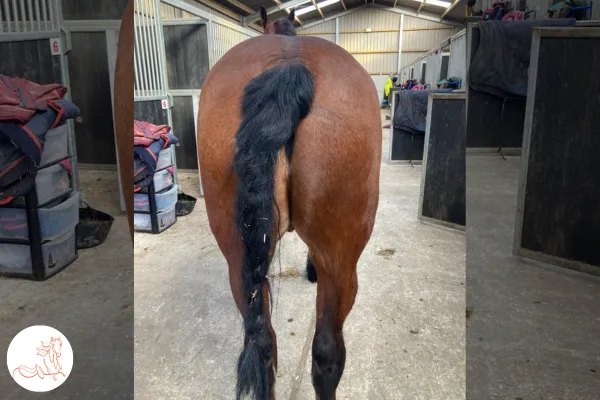
Pelvic Asymmetry in Horses: Why an Uneven Pelvis Is a Clue, Not the Conclusion
An uneven pelvis is one of the most common things we find behind a horse, and one of the easiest to misread. On 16 October Bradley Whale and I spent ninety minutes with a record number of equine practitioners and owners on one question: when is an asymmetrical pelvis actually a problem?
When I first started treating horses, my whole focus behind the saddle was symmetry. I'd stand square behind the horse, find one tuber sacrale sitting higher than the other, assess for ventral and dorsal rotation, and set out to level it. More often than not the pelvis looked so much better by the time I packed up and left the yard, and the owner was pleased, and so was I.
Then, a few weeks later, the same pattern would be back, sometimes on the same side and sometimes swapped over, and the horse was going no differently under saddle than it had before I came.
That gap, between a pelvis that looks better and a horse that hasn't changed, is where most of us get stuck. It isn't a gap in knowledge, because most practitioners know their anatomy well. It's a gap in reasoning, and nobody in our training was really asked to fill it, because qualifying is built around treating safely and ticking the boxes. That matters, and it keeps horses safe, yet it leaves out the problem solving that comes afterwards, the work of understanding why this horse has this pelvis in the first place.
Over the years my assessment changed, then my understanding, and with it my treatment. I moved from looking for symmetry to looking at function.
What the pelvis is actually built to do
The pelvis is a force-transfer structure, not a static block. It takes the thrust coming up from the feet, through the hind limbs, and passes it forward into the spine and trunk.
In the mature horse it works like a spring. Every time the horse loads its hind end, sitting in the start gates, gathering before a fence or pushing off into canter, the force drives up into the pelvis. The sacroiliac ligaments stretch a little to absorb it and then recoil, giving that energy back for the next stride. The sacroiliac joint itself moves very little. It relies on a tight, almost Velcro-like network of ligament, cartilage and muscle, and it moves through small shearing forces rather than the large swings we picture when someone says a pelvis has gone "out".
Some of the most important nerves to the hind leg pass right through this region, the femoral, obturator, gluteal and sciatic nerves among them, and the thoracolumbar fascia anchors onto the tubera sacrale and tubera coxae and runs on into the gluteal fascia and the thigh. So the pelvis is a crossroads where forces from the feet, the hind legs, the back, the saddle and the rider all meet, and a problem anywhere along those lines can show up here.
Source, compensator or messenger
Once we see the pelvis as a crossroads, the asymmetry stops being the answer and becomes a clue. A contour isn't a diagnosis. It tells us where to look, but it doesn't tell us what's wrong.
The framework we used all evening asks which of three roles the pelvis is playing. It may be the source, where the problem genuinely starts. It may be the compensator, adapting to something elsewhere, a sore hind limb, a thoracic restriction, a saddle or a rider. Or it may simply be the messenger, showing us the result of a driver that sits somewhere else entirely.
Before we decide, we ask what discipline this horse is being asked to do, what its structure is, how it's managed, and how skilled its rider is. Then we treat, and we re-test the way the horse moves, not just the way the pelvis looks. If the stride hasn't changed, we've most likely treated the messenger while the driver is still there, which is exactly why the old pattern comes back.
Why age changes everything
The same asymmetry means something completely different at different ages, so the first question for any pelvis is how old this horse is and where it sits in its development.
A foal's pelvis starts in four parts. The growth plate through the acetabulum fuses at around 14 to 16 months, which leaves two halves joined only by the cartilage of the pubic symphysis. Those two halves don't fuse until around five in mares and six in geldings, give or take six months for breed, workload and hormones, and the back part of the symphysis carries on hardening slowly into the mid-teens. The lumbar spine matures late too, and caudal lumbar growth plates have been found unfused in four-year-old Thoroughbreds.
So many horses are backed, competing and being treated while their pelvis is still in two halves. This is where the human comparison matters. In people the pubic symphysis stays a joint for life, and when it's injured the pelvis springs outwards, which is where the term "sprung pelvis" comes from. In the horse it's the opposite. The force from the hind legs drives inwards through the acetabulum, there's plenty of muscle on the outside of the pelvis and very little on the inside to push back, so an overloaded young pelvis collapses inwards.
Looking at dissections of the equine pelvis at different ages shows us what follows. As the pelvis collapses, the tubera sacrale fall towards each other and the sacrum and lumbar spine are pushed down, so the tubera sacrale become the highest point of the croup. That's the structural picture behind many hunter's bumps. Some pelvises injured young never fuse at all, and unfused pelvises have been found in horses of twelve and thirteen. When the tubera sacrale fall in, the angles of the hind legs change too, and we see the knock-on effects through the stifles and hocks. It's worth asking, for every horse with injected stifles and hocks, whether the pelvis was where it started.
A healthy fused pelvis, by contrast, keeps a good gap between the tubera sacrale, roughly three fingers on a sport horse, and horses started later and without falls tend to keep that gap into old age.
Normal isn't the same as healthy. Just because we see something all the time doesn't make it healthy and functional.
There's no agreed baseline yet for what a healthy equine pelvis looks like, and these are dissection observations rather than controlled studies. That's exactly why recording each horse's own normal matters so much, because a baseline taken at five is worth a great deal at eight.
The gelding on our list this week
Most of us will treat a gelding this week, and very few of us were taught to ask about his castration. Yet a problem scar can produce back pain, hindlimb lameness, jumping problems and behaviour changes that look almost exactly like a pelvic problem.
A 2020 case series of 20 horses found a tight fibrous band between the castration scar and the inguinal ring, in horses castrated around two and a half years earlier. They came in with back pain, hindlimb lameness, jumping problems, behaviour issues or sheath swelling, and after the band was removed surgically, owners reported improvement in 10 of the 12 horses followed up. A 2019 post mortem study of 20 geldings found neuromas in 13 of them, although we don't yet know whether they're painful.
So we ask how old he was when he was castrated, whether it was done standing or lying down, and whether there was swelling or a complication afterwards. We watch for sheath swelling, guarding when he's brushed between the hind legs, and a canter that comes and goes. A quiet, healed scar is history. A remnant that's hot, thickened, painful or band-like is a finding we refer to the vet, and then we support the horse around it and re-test. If we only ever look at the pelvis, we can end up treating the messenger again and again while the real cause sits a hand's width away.
Explaining it to the owner and the vet
We can do excellent clinical work and still lose the horse if we explain it badly. Owners hear "the pelvis is out" and expect it to be put back in, and when the pattern returns they assume the treatment failed. Words like "out", "rotated", "slipped" and "put back in" all describe a pelvis that moves a great deal, and as we've seen, it doesn't.
So we change what success means, from a level pelvis to a horse that functions better, and we tell the owner that before we start rather than after. For the owner, three sentences are usually enough: yes, the pelvis is visibly asymmetrical, we don't want to assume the higher side is automatically the problem, and success means he's more comfortable and moving better, not just looking straighter.
For the vet, four short lines keep us to what we saw and tested. What we saw: the left tuber sacrale sits higher, most obvious on the left rein. What goes with it: the right hind is taking a shorter stride. What we're asking ourselves: is the sacroiliac region the source, or is it compensating for the right hind? What we'd like from you: the stride didn't change after treatment, so we'd value your assessment of the right hind. We don't diagnose, and a clear referral like this protects the horse, protects us, and builds the trust with the vet that brings the next referral.
The better question
The pelvis that looked better when we left the yard and was back weeks later usually tells us one thing: we treated the messenger and the driver was still there. The asymmetry is a clue, not the conclusion. Before we treat, we decide which role the pelvis is playing, taking in the horse's age, sex and history, its discipline and its rider, and afterwards we re-test function and put it into words the owner and the vet can use.
The better question was never how we make this pelvis level. It's what this horse is trying to solve.
PS. If you missed the pelvic girdle webinar, the full ninety-minute recording with Bradley Whale and me is available now for £29, including the source, compensator and messenger framework, the four findings we see every week, the dissection material on age and development, and the owner and vet handover. Pelvic Girdle in Horses
For practitioners who want to take this further, The Practitioner's Eye is our six-month programme starting in January, on a mission to support equine practitioners and to change how we communicate as a multidisciplinary team. It's limited to ten practitioners, and you can join the waitlist here: Join the Waitlist
Nika Vorster is an equine chiropractor with a master's in animal chiropractic and over twenty years working with horses internationally alongside vets, trainers and farriers.
