Frequently Asked Questions
Who can join True Self Mastery classes?
Our classes are open to all women who are interested in personal development and enhancing their well-being. No prior experience is necessary.
What types of classes do you offer?
We offer a variety of classes, including mindfulness meditation, yoga, self-care workshops, and empowerment seminars.
How do I sign up for a class?
You can sign up for classes through our website. Simply browse our class schedule, select the class you're interested in, and complete the registration process online.
How long are the classes?
Class lengths vary, but most sessions are between 60 to 90 minutes. Check the specific class details on our website for exact timings.
Can I attend a class online?
Yes, we offer both in-person and online classes to accommodate different preferences and schedules. Online class details and login information will be provided upon registration.
What is the cost of the classes?
Class fees vary depending on the type and duration of the class. Please visit our website for detailed pricing information.
Is there a membership option?
Yes, we offer membership packages that provide discounted rates on classes and workshops. Membership details and benefits are available on our website.
What if I need to cancel a class?
We understand that plans change. Please refer to our cancellation policy on the website for details on how to reschedule or cancel your class.
The Thoracic Sling in Horses
A Systems Approach for Practitioners
What Are You Actually Seeing?
A practical workshop on thoracic function, movement, ratios and relationships in the horse.
Live online with Bradley Whale, B.Ost and Nika Vorster, MSc
Thursday 24 September 2026 /
6:30pm UK Recording included /
£29 / only 20 places available
WHAT WE SEE OUT AT FIELD
One shoulder looks different from the other.
The saddle keeps moving.
The thorax appears to drop.
The horse struggles to lift through the front.
One forelimb seems to load differently.
The back changes shape.
The same muscular tension keeps returning.
You have written all of these down.
None of them is wrong.
And none of them, on its own, tells you what to do next.
So what connects these findings, and what should you measure?
THE THORAX DOES NOT WORK IN ISOLATION
Most of what we assess, is through one lens at a time. A muscle, a region, a joint.
It's how we were all trained.
But the position and movement of the thorax are tied to the scapulae, the sternum, the spine,
the ribcage, the pelvis and the limbs.
Change one part and the relationships elsewhere change with it.
Which is why a horse can pass every individual check and still move badly.
And why the tension you released last month is back.
This workshop brings together our developing work on equine thoracic movement, the thoracic sling, body proportions, biomechanical ratios and coupling relationships, to give you a different way of assessing the horse.

WHAT WE WILL COVER
How the thoracic sling actually works
How it supports and positions the trunk. Thoracic lift, drop and movement. Scapular position and movement.
Left to right asymmetry.
The relationships between thorax, spine and pelvis.
So that you can tell what the thorax is doing, not just what it looks like.
Why single measurements mislead
How body shape changes what a measurement means.
Why absolute numbers are unreliable on their own.
Using ratios instead.
So that you stop drawing conclusions from a number that was never comparable in the first place.
The relationships that matter
The key coupling patterns.
How a change in one measurement alters another.
What those relationships tell you about function.
How to recognise a pattern instead of chasing individual findings.
So that you can work back from what you found to where it started.
Using it in practice
How these measurements fit into the assessment you already do.
How to monitor change over time, and after intervention or rehabilitation.
So that you can show an owner what changed, rather than tell her it feels better.
FROM "THAT LOOKS DIFFERENT" TO "THIS RELATIONSHIP HAS CHANGED"
The aim is not to give you another collection of measurements.
It is to give you a framework for understanding how those measurements relate to one another.
Instead of asking:
"Is this measurement normal?"
You can start asking:
"Is this measurement appropriate for this horse, in relation to the rest of its body?"
And more importantly:
"If this relationship has changed, what else should I expect to have changed with it?"
WHAT THAT ACTUALLY CHANGES
You get something to show her.
A figure at the first visit and a figure six weeks later, instead of "he feels freer through the shoulder".
You get a reason for the next appointment.
Not because you asked for one, but because there is something to retake and a direction of travel worth protecting.
You get to settle the saddle conversation.
She says it fits. You say he cannot lift under it. At the moment neither of you can prove anything and the owner is caught in the middle.
You get to say something specific in front of a vet, which changes where you sit in the conversation on that yard.
WHO THIS IS FOR
Equine therapists, osteopaths, physiotherapists, chiropractors,
veterinary professionals, rehabilitation practitioners, saddle fitters,
trainers, and anyone else working with equine movement and performance.
You do not need a research background.
You do need to be someone who assesses horses regularly and wants a better way of joining up what you find.
Meet the Speakers
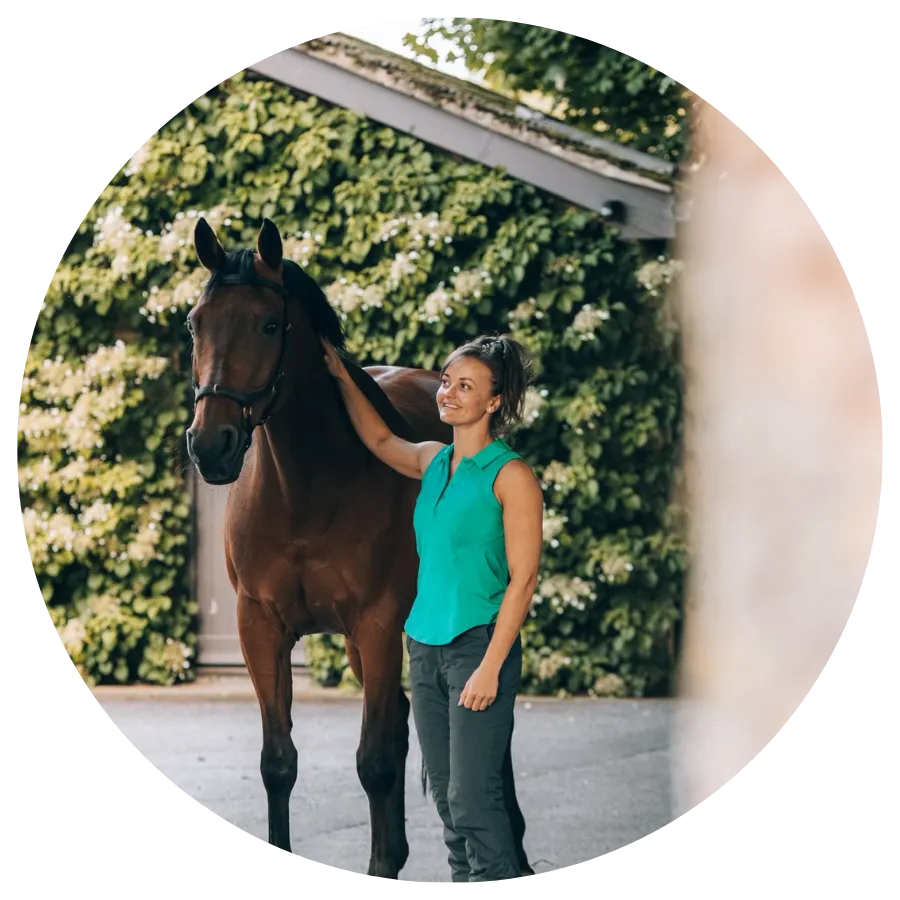
Nika Vorster, MSc
Nika Vorster is an internationally recognised equestrian performance specialist, NLP practitioner coach, and biomechanics expert with over thirty years of hands-on experience working with horses at the highest level.
A former flat jockey and GB MCI Dressage representative, Nika has competed, treated, and worked with horses and riders across Dubai, Asia, Australia, the United Kingdom, and Ireland, operating at Olympic level with high performing athletes. Her career spans every layer of the equestrian world, from grassroots horsemanship to elite international competition.
Combining three decades of practical expertise with advanced performance coaching and a Masters degree, Nika works with animal health practitioners and riders to sharpen clinical thinking, improve horse-rider performance outcomes, and develop practices that perform at the highest level.
Nika is the founder of The Rider Performance Code and the author of The Female Rider Code, due for publication in October 2026.