When You Don't Have the Words to Speak Up for Your Horse
I've always struggled with language.
I'd rather show you what I mean than try to explain it.
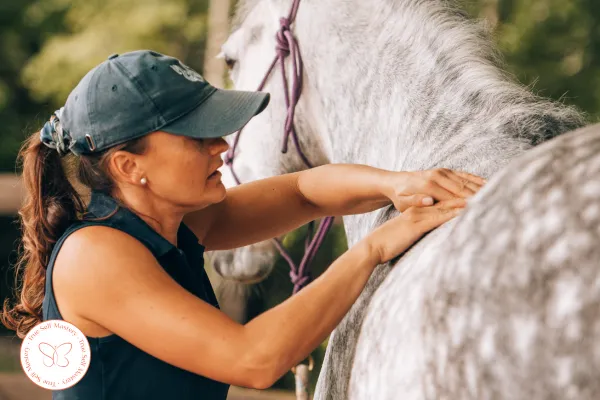
Put me in a room with a horse and I can read everything. The tension in the poll. The restriction through the shoulder. The disconnect between rider and horse. The moment their breathing changes. The subtle weight shift that tells me exactly where the problem lives.
But the moment someone asks me to explain what I'm seeing, I freeze.
The Cost of Silence
For years, I watched horses trying to communicate. I saw the patterns. I felt what they needed.
But I couldn't articulate it clearly enough to make others understand. Vets wanted technical precision I couldn't provide. Trainers needed concrete direction I struggled to give. Owners just wanted to know what was wrong, and I'd stand there searching for words that never came.
The words weren't there.
I'd point. I'd demonstrate. I'd adjust the horse's body and hope the owner would see what I was seeing.
Sometimes it worked. Often it didn't.
So I stayed quiet more than I should have.
I showed people instead of telling them. I adjusted horses physically instead of teaching riders how to prevent the problem. I'd see a horse bracing through their ribcage and know exactly why—the rider was holding tension in their hip—but I couldn't find the words to explain it in a way that made sense.
And horses kept suffering because I couldn't speak up effectively.
The frustration built over years. I knew what I was seeing. I understood the patterns. I could feel the solutions in my body before I could see them in the horse.
But without language to bridge that gap between knowing and explaining, I couldn't help the way I wanted to.
Finding the Framework
Then I built The Horse Listener.
Not to solve my language problem—I built it to help riders understand what their horses were showing them. I wanted to give them a way to read their horse's body language, manage their own tension, and create authentic connection.
But in creating the framework, something unexpected shifted.
Observe. Ask. Test. Adjust.
Those four steps gave me a structure for what I'd always known intuitively.
Suddenly, instead of trying to explain everything at once—the tension, the restriction, the rider's contribution, the horse's response, the history, the solution—I had a clear pathway through it.
First, what are you observing? Just the facts. What does the horse's body actually show you?
Then, what might that mean? What question does this observation raise?
Next, what can you test? One small thing to try based on what you're seeing.
Finally, how do you adjust based on the horse's response?
The philosophy around it—horses as mirrors, reading tension, understanding connection—gave me vocabulary for what I'd been seeing my entire life. The framework organised my intuition into something I could actually communicate.
And suddenly, I could explain exactly what was happening.
Not in vague terms like "he's uncomfortable" or "something's off."
But specifically: "He's bracing through his ribcage because you're holding tension in your left hip. When you release that, he'll soften. Watch his breathing change when you do."
What Language Actually Does
The framework gave me language.
And language gave me the ability to finally speak up for horses.
To advocate clearly when I saw something that needed addressing.
To teach riders what their horses had been trying to tell them all along, in words they could understand and act on.
To explain why a particular saddle wasn't working, or why a training method was creating more tension, or why the horse kept resisting the same movement.
I didn't realize how much my lack of language had been costing the horses I worked with until I finally had it.
Now I watch the same transformation happen with the riders I work with.
They come in knowing something's wrong but unable to name it. They feel their horse's tension but can't pinpoint where it lives or why it's there. They want to help but don't have the words to describe what they're seeing—not to their trainer, not to their vet, not even to themselves.
One rider told me she'd been trying to explain her horse's stiffness to three different professionals for months. Each one gave her a different answer because she couldn't describe what she was actually seeing clearly enough. She knew it was there. She felt it every ride. But without the language to articulate it, she couldn't get the help her horse needed.
After one session working through the Observe → Ask → Test → Adjust process, she sent me a message: "I finally understand what I've been trying to say for months. And now I can explain it to my vet in a way that actually makes sense."
The Framework as Translation
The Horse Listener gives riders that language.
Plain language for what you're actually seeing.
Just a clear, simple framework for reading what's actually there and responding to it.
When you have language for what you're experiencing, everything changes.
You can understand what's happening instead of just sensing that something's wrong.
You can regulate your own emotions around it because you know what you're dealing with.
You can ask for help in ways people can actually understand and respond to.
And most importantly—you can finally speak up for your horse.
Not just to professionals. To yourself.
You can name what you're seeing, which means you can address it. You can track whether it's getting better or worse. You can make informed decisions about what your horse needs instead of cycling through solutions hoping one works.
What's Waiting
That's what The Horse Listener does.
It gives you the vocabulary you've been missing to understand what your horse has been showing you all along.
Six weeks. Three stages. Moving from ground work without tack, to ground work with tack, to riding.
By the end, you'll have language for every interaction with your horse. You'll know exactly what they're communicating through their body, and you'll have the words to respond effectively.
Have you ever struggled to find the words? Then finally found your voice?
How did it feel?
That's what's waiting for you.
NIKA
⤥ Learn more about The Horse Listener: https://www.nikavorster.com/the-horse-listener
